Solving digital assets puzzles
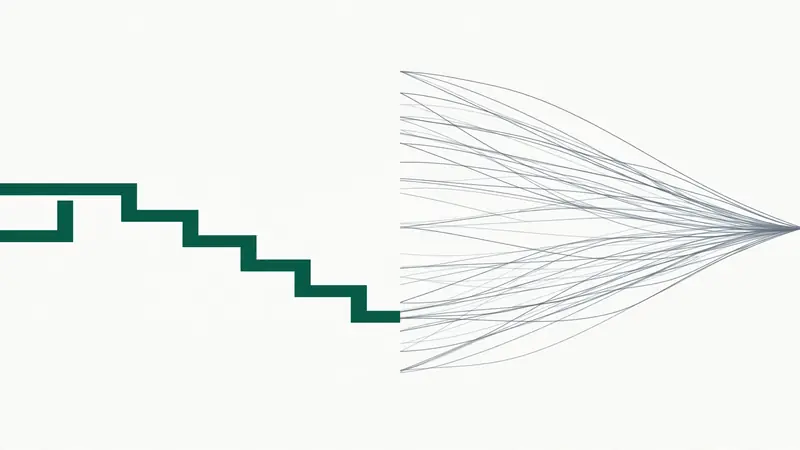
We rebuild the path from question to answer from days to minutes, agent-caly.
Independent. No reseller agreements. No vendor commissions.

We rebuild the path from question to answer from days to minutes, agent-caly.
A list of ten complaints is an inventory, not a diagnosis. In almost every company we assess, the complaints collapse into three causes.

The central object of the business — the project, the order, the case, the shipment — has no single record anywhere. It exists in fragments across the ERP, a vendor platform, a marketing spreadsheet, a contract folder, a sales deck. Each piece is correct inside its own boundary. None of them meet. All the manual reconciliation people complain about is the work of reassembling, by hand, an object the systems never assembled.

The complaint is rarely that data is missing. It is that getting it takes three days and two favors. Excessive confidentiality and absent ownership turn people into bottlenecks. A senior person holds a spreadsheet only they understand. When an answer costs three days, people stop asking. The company does not just answer slowly — it stops asking, and decisions quietly revert to intuition.

Many companies have outsourced the exact point where customer data would be captured. They sell through a platform that owns the customer record. Marketing then buys reach instead of talking to people who already bought. Pricing runs without a demand base. Support cannot see what was sold. Every transaction is a one-off that could have been a relationship. The cost shows up as acquisition spend, not as missing data.
Fix the three causes and the ten complaints go with them. Fix the ten complaints and you get ten projects.
We establish what exists with evidence. Process maps based on observation, not interviews alone. System inventory with actual usage, integration flows, contract terms, cost baseline including manual workarounds, risk and privacy gaps. Nothing asserted without a traceable source.
Target architecture, data strategy, customer-data strategy, governance and privacy model, and the design of the technology function itself: roles, seniority, reporting line, cost. We design for the company you run, not the vendor roadmap.
An opportunity register quantified in ranges with declared confidence, ranked by an explicit weighted model the client calibrates. We separate hard cost savings from created capacity from potential revenue. We never present freed-up time as cash.
Vendor-neutral selection, delivery oversight, adoption and training, and benefit tracking against the baseline we established. A project is not successful because it launched. It is successful when the question that used to take three days now takes three minutes.
We do not resell software, take vendor commissions, or hold referral agreements with any technology vendor. No marketplace, no partner tier. That means we can recommend keeping what you have, fixing configuration, or building nothing at all. Our only loyalty is to the problem. If a recommendation saves money by not buying, we still make it.
We never recommend swapping a system before establishing what it does today, who uses it, what it actually costs, and whether configuration or process would fix it more cheaply. Replacement is expensive and disruptive. Many systems are misused, not broken. We document current use with evidence, not with what the license says it should do.
The sequence is always: business problem → current process → root cause → desired outcome → compared options → financial impact → implementation plan. Never tool-first. A tool is one way to solve a process problem. We keep process, ownership, and data decisions in front of system decisions, so you don't automate a broken process.
Every estimated benefit is given as a range, with a declared confidence level, and we separate hard cost savings from created capacity from potential revenue. We never present freed-up employee time as cash savings. Assumptions are listed next to the number, not in an appendix. If the assumption changes, you can see how the range moves.
It should be solved with integration and workflow automation, which is cheaper and auditable. AI earns its place in a narrower set of problems — document extraction, unstructured search and retrieval, summarization, assisted drafting, routing, demand and propensity models.
We apply the same test to every AI candidate: trigger, inputs, decision, systems involved, human review requirement, exception handling, expected volume, cost per transaction, failure mode, monitoring, fallback.
| Deterministic automation | Genuine AI use case |
|---|---|
| Order to cash status sync across ERP and vendor portal. No model needed, just an integration. | Extracting terms, dates, and renewal obligations from 800 signed contracts in a file share. |
| Routing a support case by product, tier, and language based on explicit rules. | Routing a support case by intent inferred from free-text description when rules fail. |
| Generating a weekly operations pack from defined sources into a fixed template. | Summarizing 40 pages of customer call notes into risks and next steps for the account owner. |
| Enforcing pricing approval when discount exceeds threshold. Yes/no logic. | Forecasting demand by SKU by channel where history is noisy and external factors matter. |
| Matching a shipment to a purchase order when identifiers already exist. | Finding the prior case that looks like this one when no identifier links them. |
We start with the left column. We move to the right only when the problem requires judgment over unstructured inputs.
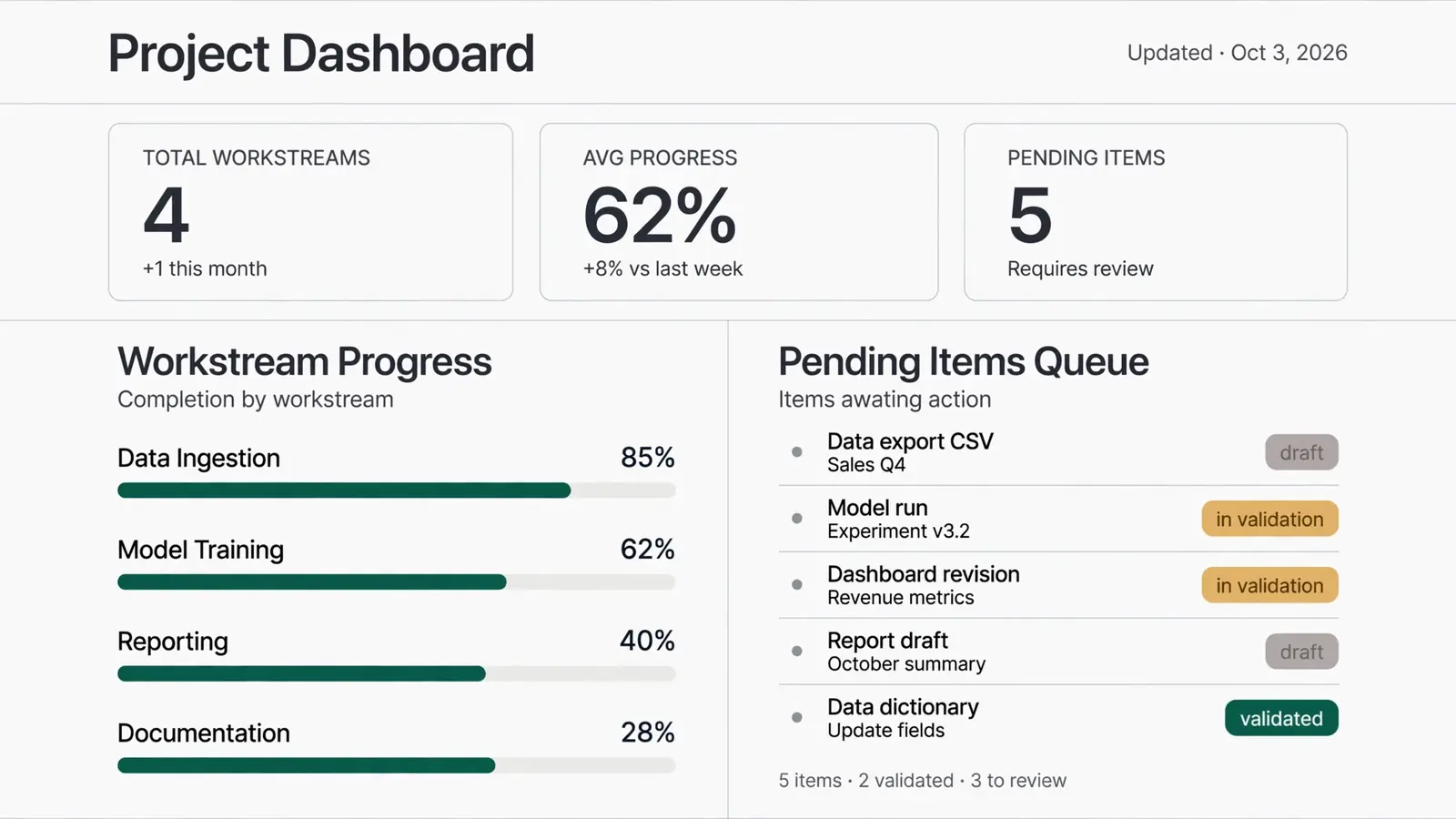
Every engagement runs on a live web dashboard where you see progress, coverage by area, the open queue of requested information with owner and due date, findings as they form, and deliverables as they are published — in real time, not in a final report.
A consultancy diagnosing information problems cannot run its own project by email and a closing presentation.
A fixed-scope, fixed-fee diagnostic, 6 to 8 weeks. Current state with evidence, target options, opportunity register with ranges and confidence, sequencing. You end with a plan you can execute with or without us.
Starts with access to people and systems, not with a workshop deck.
Ongoing technology leadership during execution. We hold the architecture, vendor-neutral selection, delivery oversight, and benefit tracking. Your team does the work. We keep it coherent.
For companies that need senior coverage without adding a permanent layer.
A senior technology counterpart for the executive team. Monthly review of progress, decisions, risks, spend, and hiring. Direct, specific, no slide factory.
Useful when the problem is not a project but a series of decisions made without a technical voice in the room.
Tell us what is hard to answer today that should be easy. If we can help, we will say so. If we cannot, we will say so quickly.
Direct email: hello@qwr.consulting
Replace with your real address in contact.html and in the site config.